
Fleming Analytic • Independent Community Analysis
What we know, what we don’t, and how to be heard before the vote · August 2026
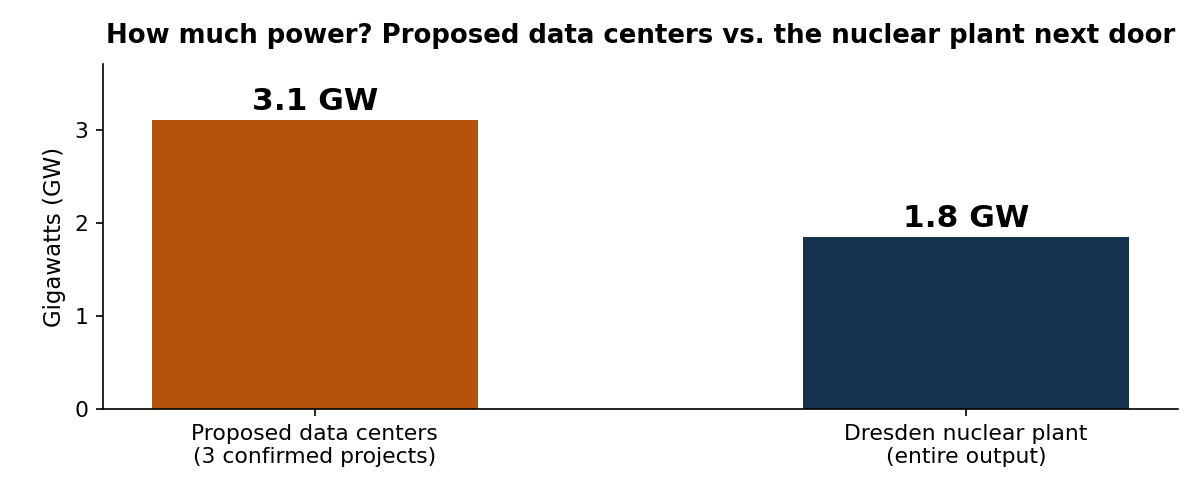
These are the larger projects that are public. There are almost certainly more — many are filed under shell companies with code names, so even a complete count is hard to get.
| County | Project / Developer | Power | Status |
|---|---|---|---|
| Will | Joliet Technology Center — PowerHouse + Hillwood (795 acres, 24 bldgs) | 1,800 MW | Approved |
| Grundy | Morris Technology Park — Tract (343 acres, 2.9M sq ft) | 1,000 MW | Proposed |
| Grundy | Coal City Campus — Aligned (11 buildings, ~300 acres) | not disclosed | Proposed |
| Grundy | Grundy site — Cielo Digital | 300 MW | Proposed |
| DuPage | Wood Dale — CyrusOne (6 buildings, ~1.4M sq ft) | not disclosed | In development |
| DuPage | Lisle, Itasca (NTT), Carol Stream — smaller sites | ~50 MW & less | Proposed / building |
The projects do not build their own power plants. They connect to the ComEd electric grid — the same grid that serves your home:
And the grid is already tight. PJM (our regional grid) could be about 15 GW short of power by 2030, and ComEd forecasts shortfalls in northern Illinois by 2029. Regulators found that about 70% of this year’s regional electricity-cost increase came from data-center demand — a cost shared by all ratepayers, including you.
These campuses are not mainly for training AI models — they are for running them for users. The industry is betting that demand will explode as AI “agents,” reasoning models, and video generation use far more computing power per task, and as AI gets built into more products.
But much of this is a speculative race. Every company is adding capacity on the assumption the demand will arrive. If it doesn’t — or if AI never earns back its enormous cost — a community can be left holding the water use, the grid strain, and the tax breaks for buildings that sit half-empty or are abandoned. That is exactly why the decommissioning bond and rate-protection conditions below matter: they protect you if the boom does not last.
The power problem is large and confirmed. The water problem is real but depends on the project — and sits on an aquifer that is already failing.
Several rows in the table above say “not disclosed.” That is not a gap in our research — it is how these deals are structured.
Across the country, data-center developers routinely ask city and county officials to sign non-disclosure agreements before negotiations even begin. In Virginia, one review found roughly 80% of localities with proposed or existing data centers had them. What those agreements typically cover is precisely what a resident would want to know before a vote:
Projects are also commonly filed by shell companies under code names, so even the developer’s identity can stay unclear until late in the process. The practical effect is that a handful of elected officials may hold information their constituents cannot see — and may not be free to discuss it at the hearing where the vote is taken.
Illinois SB 4016 (Sen. Ram Villivalam, introduced February 2026) would prohibit non-disclosure agreements for data-center projects, and require cumulative impact assessments, public notice, and community benefits agreements.
The General Assembly adjourned its spring session without passing it, or the related POWER Act. In response, Gov. Pritzker paused new Data Center Investment Program tax-incentive agreements effective July 1, 2026, and asked lawmakers to build a comprehensive framework during the veto session this fall.
That session is the next real opening. If you contact a state legislator about anything on this page, SB 4016 is the bill to name.
The state declined to set rules, so the only real leverage is at the local approval hearing. Once a project is approved, the binding numbers move to other agencies where there is no public vote. Before approval, residents and officials can ask that these be made conditions of approval, in writing:
Data centers usually need a special-use permit. Who votes on it depends on whether the site sits inside a city/village or on unincorporated county land — but in both cases, the public may speak at a hearing before the vote.
Attend the Zoning Board of Appeals or Plan Commission hearing, and contact your County Board member (unincorporated land) or your Mayor and City Council / Village Board (city or village) to ask for the protections above. Share this page with neighbors.
Nothing on this tab is about any specific project in Will, DuPage or Grundy County. It is about how data centers are financed across the country. It sits here because it answers the question the local page raises — if the demand does not arrive, who absorbs the loss?
The speculative race above is being financed with borrowed money, and it is worth understanding where that money comes from. Increasingly, a finished data center is placed into its own legal entity, that entity sells bonds backed by the rent, and those bonds are bought by life insurance companies and pension funds — which is how they end up, indirectly, in ordinary people’s retirement savings.
In July 2026 the Securities and Exchange Commission confirmed that these bonds are not legally “asset-backed securities,” which removed a requirement, written after the 2008 crash, that the companies issuing them keep 5% of the risk themselves. This short explainer walks through what happened and why it matters.
It is worth being precise about who carries what. The tech company renting the building is not off the hook: on the largest deal so far, Meta’s 30-year lease is what repays the bonds, and rating agencies priced them just one notch below Meta’s own credit. What the separate entity achieves is something else — the $27 billion of borrowing does not appear on Meta’s balance sheet. More than $120 billion of data-center spending has moved off the books this way in under two years. That is what members of Congress mean when they say these structures “obscure true leverage.”
This part is national context, not a local finding. It is about how data centers are financed across the country, not about any specific project in Will, DuPage or Grundy County. It matters here for one reason: it goes to the question above — if the demand does not arrive, who absorbs the loss? The financing has been arranged so that the people holding that risk are largely pension funds and insurers, and the disclosure rules that would let anyone monitor it were removed.
The explainer presents the SEC’s reasoning as well as the criticism of it. Sources are cited on screen.
A detailed technical article covers the whole picture: the bond structure and its trigger ladder, who issues the paper and at what price, how the four rating agencies assess it and where they disagree, what actually breaks these deals, and the July 2026 SEC letter in full — including whether Congress can reverse it.
It is written for readers who want the mechanics rather than the summary.